The carbon in our bodies and the oxygen we breathe were forged in stars. Earth could form only after earlier generations of stars released those elements back into space, where they mixed with gas and became raw material for new stars and planets.
Astronomers have now captured one part of that return journey in incredible detail. A new image of the Helix Nebula shows fragments cast off by the star that created the nebula, now plowing through surrounding gas. Twenty-two curved shock fronts trace the debris as it is stripped, broken apart and gradually absorbed into interstellar space.
The discovery, published online August 12 in Nature, reveals a crucial step in the cosmic recycling process that helped make our own existence possible—and that our Sun will one day join.
“We are seeing material shed near the end of a star’s life being broken apart and returned to the galaxy,” said lead author Pieter van Dokkum, of the Dragonfly Focused Research Organization (FRO) and Yale University. “That handoff—from recognizable stellar debris to the diffuse gas between the stars—has been very difficult to observe. Far in the future, the Sun will go through a broadly similar process, and its material will enter the same cycle.”
A familiar nebula, seen in a new way
The Helix Nebula, about 650 light-years from Earth, is one of the closest and best-studied planetary nebulae. Its familiar bright ring formed from material expelled by the star near the end of its life. At the centre lies the remnant of that star, a white dwarf.
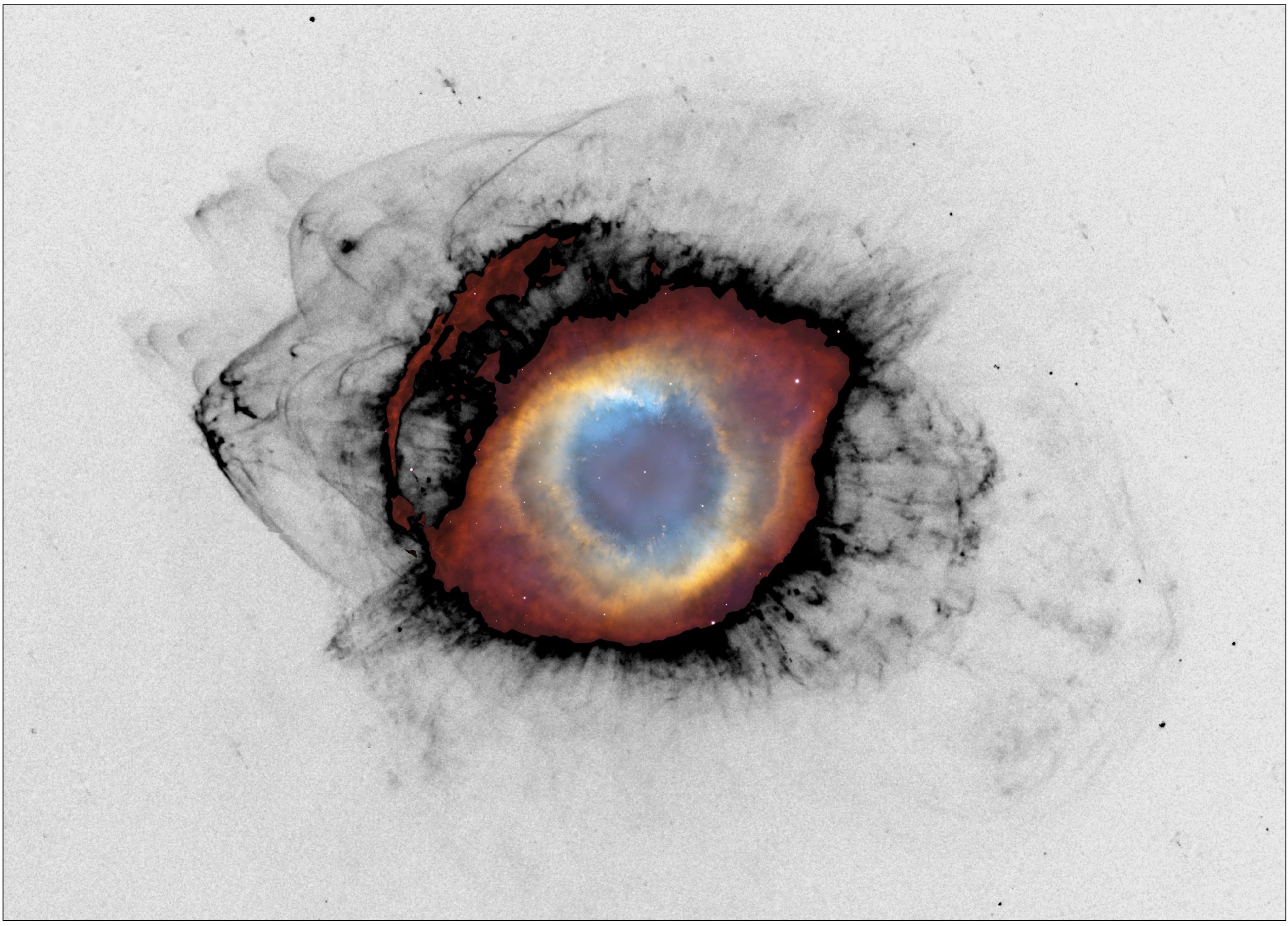
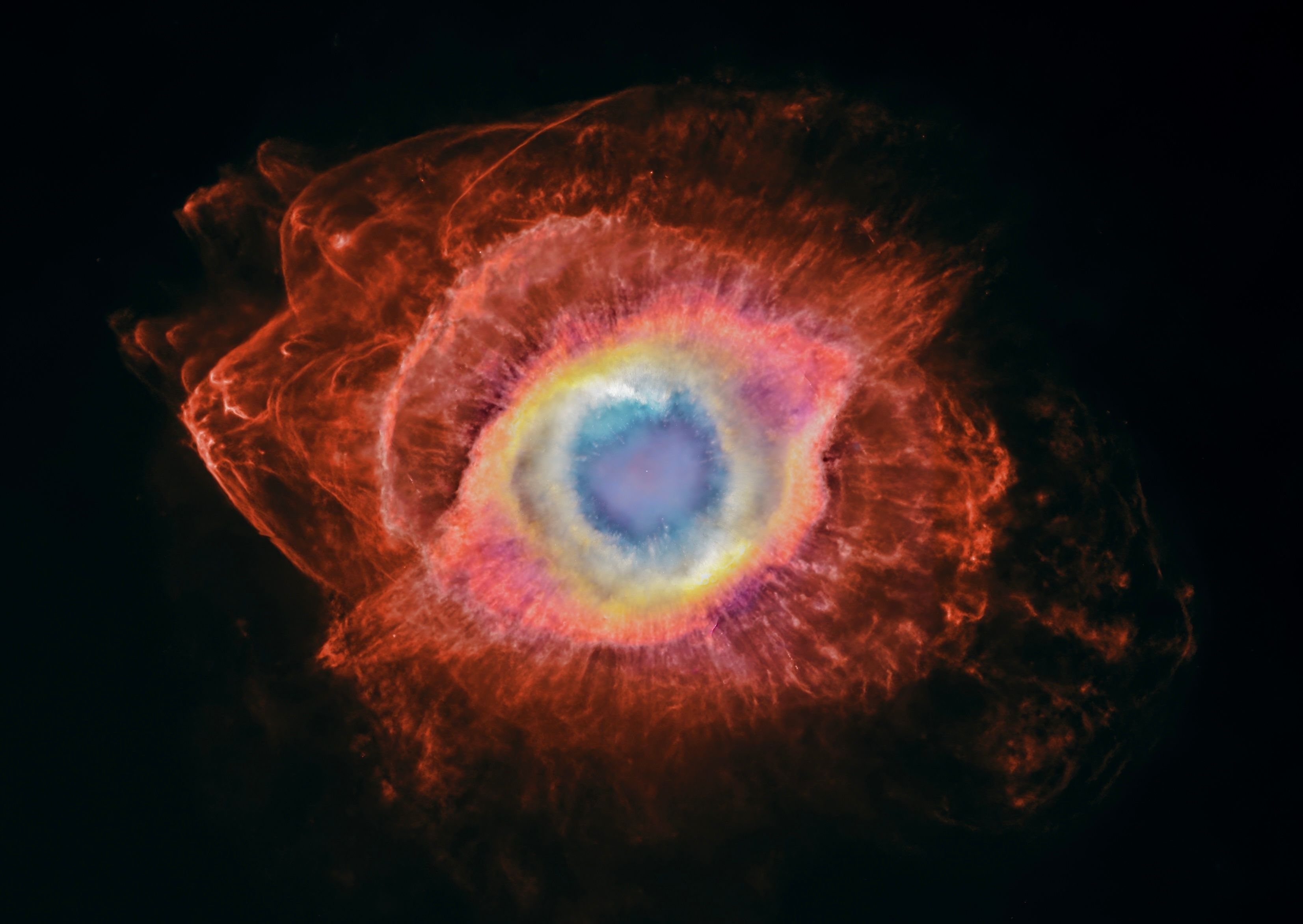
The new observations reach far beyond that bright inner nebula, into an extraordinarily faint halo. There, on the eastern side of the Helix, the researchers found a forest of 22 complete or partial bow shocks.
A bow shock is similar in shape to the wave that forms in front of a boat moving through water. In the Helix, mostly invisible clumps of stellar debris are moving rapidly through the thin gas between the stars. The glowing arcs mark where those clumps collide with the surrounding gas.
The shocks change strikingly with distance from the central star. Those nearer the centre are large, thin and sharply defined. Farther out, they become smaller, fuzzier and increasingly fragmented.
The researchers interpret that progression as evidence that the clumps are being steadily eroded as they travel. They estimate that an individual fragment remains coherent for only about 10,000 years once it is exposed to the surrounding gas. After that, its material is largely shredded and mixed into interstellar space.
The estimate describes how long recognizable fragments survive, rather than the age of the Helix itself. But it provides a rare measurement of the missing handoff between material expelled near the end of a star’s life and the diffuse gas from which future stars and planets can form.
A discovery hidden in a calibration image
The team did not originally observe the Helix to investigate stellar recycling.
Because the nebula is large, bright and extensively studied, the researchers selected it as an early calibration target for the new MOTHRA telescope. The Helix has been photographed thousands of times, and they did not expect it to reveal an entirely new phenomenon.
“We thought we were taking a calibration image of one of the best-known nebulae in the sky,” said co-author Roberto Abraham, of the Dragonfly FRO and the University of Toronto. “Instead, we found this extraordinary network of bow-shaped structures. It was immediately clear that the faint outer Helix was telling us a story that had largely been missed.”
MOTHRA—the Modular Optical Telephoto Hyperspectral Robotic Array—is under construction at the El Sauce Observatory in Chile. Rather than relying on a single large mirror, it combines many high-end telephoto lenses equipped with filters designed to isolate the extremely faint glow of gas across large areas of sky.
When completed, MOTHRA will contain 1,140 lenses. The Helix observations were made during the telescope’s early construction, when only its first five mounts were operating. The resulting data are equivalent to a mere 20 minutes of observing with the completed array.
The discovery is therefore both a new view of the Helix and an early demonstration of what MOTHRA will be able to accomplish. The completed telescope will be able to search efficiently for similar structures around other nearby planetary nebulae, along with its primary science goal of studying gas around and between galaxies.
A preview of the Sun’s distant future
The star that created the Helix was not an exact twin of the Sun, but the Sun is expected to follow the same broad path. Far in the future, it will expand, shed much of its outer material and end as a white dwarf, with the expelled gas glowing around it for a time.
The Helix therefore connects our own past and future. Material expelled by earlier stars became part of the cloud from which the Sun, Earth and life formed. Eventually, the Sun will return some of its own material to the galaxy.
The Helix offers more than a view of the aftermath of another star’s death. It provides a first-of-its-kind distant preview of how material from our own Solar System will eventually be returned to interstellar space.
That material may one day become part of new clouds, new stars and perhaps new planets—continuing the cycle that once produced the ingredients from which Earth and life were formed.
Publication
“Numerous bow shocks in the outer Helix Nebula”
Pieter van Dokkum, Roberto Abraham, William P. Bowman, Seery Chen, Steven R. Janssens, Deborah M. Lokhorst, Imad Pasha and Carter Rhea
Nature, August 13, 2026 (https://www.nature.com/articles/s41586-026-10724-z)
An accompanying Research Briefing, “Bow shocks reveal how a dying star returns matter to interstellar space,” appears in the same issue of Nature.
Funding
The development of MOTHRA and Dragonfly FRO have been made possible by the funding and continued strategic support of Alex Gerko, founder and CEO of XTX Markets. Dragonfly FRO was launched in partnership with Convergent Research.
Media contacts
Scientific contact
Pieter van Dokkum
Dragonfly Focused Research Organization / Yale University
pieter.vandokkum@dragonfly1000.com
Website
http://www.mothratelescope.org
Press contact
Lisa Sloan
Supporting press release
Supporting animation
An animation illustrating the findings reported in the Nature paper is available (https://drive.google.com/file/d/1w3lFwMFOhUD9URZ4qOA4nzGh3E5oMrG6/view?usp=drive_link). It opens with a dying star casting off a shell of gas, which glows in the light of the star that produced it. At 0:08, the shell fragments into clumps of debris. These clumps travel outward through the interstellar medium—the extremely tenuous gas, barely denser than a vacuum, that fills the space between the stars. Because the clumps move faster than the local speed of sound, each one drives a bow shock through the surrounding gas, shown forming at 0:18. Beginning at 0:30, the animation is compared side by side with sections of the new MOTHRA image. Animation credit: Alexandre Dizeux and Dragonfly FRO. Credit for the combination of MOTHRA, Hubble, and Kitt Peak data: Andrew McCarthy (andrew@cosmicbackground.io) and Dragonfly FRO.
Red image caption
The Helix Nebula and the cosmic recycling of stellar material. The bright central nebula surrounds a white dwarf, the remnant of the star that created it. Farther out, newly revealed bow shocks show fragments of material cast off by that star colliding with surrounding interstellar gas. The fragments become progressively smaller and more disrupted as they are stripped, shredded and mixed into space. The new MOTHRA data are combined with previous data from the Hubble Space Telescope and the Kitt Peak 4m telescope to create this color image. Credit for the previous data: NASA, ESA, C. R. O’Dell (Vanderbilt University) and M. Meixner, P. McCullough and G. Bacon (Space Telescope Science Institute). Credit for the combination of MOTHRA, Hubble, and Kitt Peak data: Andrew McCarthy (andrew@cosmicbackground.io).
Grey scale image caption
The Helix Nebula and the cosmic recycling of stellar material. The bright central nebula surrounds a white dwarf, the remnant of the star that created it. Farther out, newly revealed bow shocks show fragments of material cast off by that star colliding with surrounding interstellar gas. The fragments become progressively smaller and more disrupted as they are stripped, shredded and mixed into space. The new MOTHRA data is shown in black, with previous data from the Hubble Space Telescope and the Kitt Peak 4m telescope in color. Credit for the previous data: NASA, ESA, C. R. O’Dell (Vanderbilt University) and M. Meixner, P. McCullough and G. Bacon (Space Telescope Science Institute).